



The State of Governance & Director Pay – What We Learned from Our Latest Webinar
Two weeks ago, we hosted our Navigating Governance & Setting Pay for Directors webinar alongside Strategic Pay, and it sparked some great conversations. The discussion, backed by real-world data from Strategic Pay’s latest Pulse survey, provided valuable insights into governance trends and director remuneration.
From boardroom dynamics to remuneration best practices, here are some of the key takeaways and why they matter for boards of all sizes.
1. Board Meetings Are More Positive Than Expected, But Is That the Whole Story?
A standout statistic from the survey was that 75% of directors rate their board meetings as good or excellent. On the surface, this is an encouraging result—after all, well-run meetings are the backbone of good governance.
But there’s another side to the story. Executives weren’t as positive, suggesting that management might not always feel heard or supported by the board.
A simple way to bridge this gap? Boards should actively check in with management—not just assume everything is running smoothly. Ask the question: Are you getting what you need from these meetings? Sometimes, the most valuable feedback comes from those who aren’t speaking the loudest.

2. Director Pay: If You Don’t Have a Policy, It’s Time to Get One
Many boards still approach director remuneration on an ad-hoc basis—deciding pay as they go. But without a structured policy, boards risk inconsistency, undervaluing their directors, or even struggling to attract the right talent.
Best practice? Conduct an annual review (even if no increase is made) and have a clear, documented policy on how pay is set and benchmarked. Director roles come with significant time commitments and responsibilities, and ensuring pay reflects this is crucial to good governance.
If your board hasn’t discussed director pay in a while, it might be time to schedule a conversation.
3. Board Evaluations & Skills Matrices, Still Underused
We talk a lot about governance best practice, yet the survey revealed that:
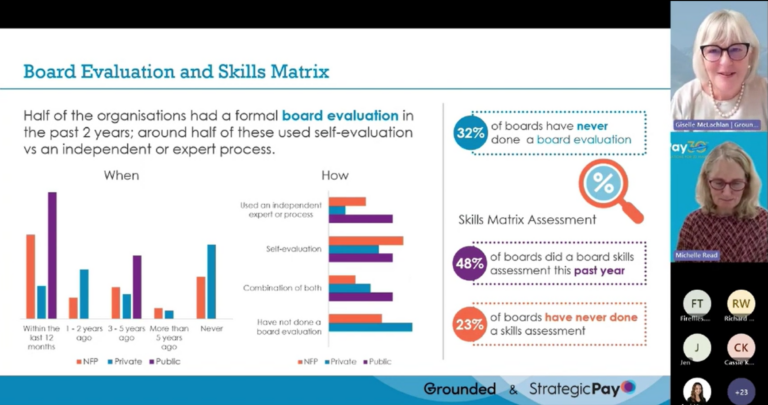
- 32% of boards have never conducted a formal evaluation.
- Only half of boards conduct a skills assessment.
That’s a problem. Regular board evaluations aren’t just a nice-to-have—they’re a necessity. They help identify blind spots, improve accountability, and ensure the board is functioning at its best.
Likewise, skills matrices are an essential tool for making sure the board has the right expertise to meet its strategic goals. Without one, boards risk making decisions with gaps in critical areas like finance, risk management, or industry-specific knowledge.
If your board hasn’t evaluated in the last two years, now is the time to start. It’s not about checking a compliance box—it’s about building a stronger, more effective board.
4. Succession Planning: A Risky Oversight
The survey showed that 40% of boards don’t proactively plan for leadership transitions. That’s a staggering number, considering how crucial fresh perspectives and diverse leadership are to effective governance.
Without a clear succession plan, boards can find themselves scrambling when a key director or chair steps down. The result? A reactive, rushed appointment process rather than a well-thought-out transition.
Strong governance means looking ahead—not just for the next meeting, but for the future of the board itself. A good starting point? Regularly review your board composition and identify potential future leaders before you need them.
5. The Chair’s Role in Governance Effectiveness, More Than Just a Title
The role of a board chair is about more than running meetings. Using the 5Ts framework, we explored how chairs set the tone, manage time, develop board talent, foster teamwork, and uphold board traditions.
A good chair ensures that governance conversations—like director remuneration—aren’t just afterthoughts but structured, strategic discussions.
If these conversations aren’t happening at your board, it may be time to prompt the chair or reflect on whether the board is getting the leadership it needs.
What’s Next? Keep the Governance Conversation Going
These insights are just the beginning. Good governance isn’t about perfection, it’s about continuous improvement and open conversations.
Want to dive deeper into governance trends and director pay best practices? Join us for our next webinar and stay ahead of the curve.
Register your interest here: https://www.strategicpay.co.nz/navigating-governance-webinar-registrations-of-interest/
We look forward to continuing the discussion with you!